
F/A-18A Hornet
Plan your VisitSummary
About the F/A-18A Hornet
History
The story of an iconic aircraft
The McDonnell Douglas F/A-18 Hornet was designed in the 1970s to be a highly versatile aircraft due to its avionics, cockpit displays, and excellent aerodynamic characteristics, with the ability to carry a wide variety of weapons. The aircraft can perform fighter escort, fleet air defense, suppression of enemy air defenses, air interdiction, close air support, and aerial reconnaissance. Its versatility and reliability have proven it to be a valuable carrier asset. The Hornet first saw combat action during the 1986 United States bombing of Libya and subsequently participated in the 1991 Gulf War and 2003 Iraq War. The F/A-18 Hornet served as the baseline for the Boeing F/A-18E/F Super Hornet, its larger, evolutionary redesign, which replaced both the older Hornet and the F-14 Tomcat in the U.S. Navy.
Dimensions
Dimensions: Wingspan – 40 ft 4 in w/ AIM-9 Sidewinders on wingtip LAU-7 launchers
Length – 56 ft 1 in
Height – 15 ft 5 in
Weights: Empty – 23,000 lbs
Maximum Takeoff Weight – 51,900 lbs
Performance
Maximum Speed – Mach 1.8 (1,381.08 mph)
Initial climb rate – 50,000 ft/min
Range – 1,253 mi
Powerplant
Two General Electric F404-GE-402 afterburning turbofan engines w/ 11,000 lb of thrust
Armament
Fixed: One 20 mm (0.787 in) M61A1 Vulcan nose
mounted 6-barrel rotary cannon, 578 rounds
F/A-18A BuNo 163152 was first delivered in 1987 to VFA-161 “The Chargers”. It also served with VFA-125 the “Rough Raiders” in 1988, VMFA-531 the “Grey Ghosts” in 1989, VMFA-314 ”The Black Knights” from 1990-1995 where it also participated in Operation Desert Storm, and finally VMFAT-101 from 1996 to 2005 at MCAS Miramar. On April 4, 2005, this aircraft was struck from the inventory and towed to the Flying Leatherneck Aviation Museum where it remained on display until March 2022 when it was transferred to its new home at the Pacific Coast Air Museum. This aircraft is on loan from the National Naval Aviation Museum at Pensacola, Florida.
The Name on the Plane
Frank E. Petersen Jr. (March 2, 1932 – August 25, 2015) was a United States Marine Corps lieutenant general. He was the first African-American Marine Corps aviator and the first African-American Marine Corps general. Petersen enlisted in the U.S. Navy in June 1950 as a seaman apprentice and served as an electronics technician. When Petersen aced the Navy’s entrance exam, the recruiter told him he would make a “great steward”. However, being
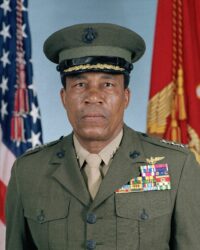
motivated by the recent Korean War combat death of the Navy’s first black aviator Jesse L. Brown in December, Petersen vowed to be a combat pilot. He flew over 350 combat missions during the Korean War and the Vietnam War and had over 4,000 hours in various fighter/attack aircraft.
He held command positions at all levels of Marine Corps aviation, commanding a Marine Fighter Squadron, a Marine Aircraft Group, and a Marine Aircraft Wing. He was also the first African-American to command a fighter squadron (VMFA-314), a fighter air group, an air wing, and a major base. On February 23, 1979, he was promoted to Brigadier General, becoming the first African-American general in the Marine Corps. Petersen retired from the Marine Corps in 1988 after 38 years of service and was presented the Distinguished Service Medal for exceptionally meritorious service. In 2010, President Obama appointed Petersen to the Board of Visitors to the United States Naval Academy. On November 9, 2016, Secretary of the Navy Ray Mabus officially announced that an Arleigh Burke-class destroyer would be named in honor of Petersen. The USS Frank E. Petersen Jr. was commissioned on May 14, 2022, in Charleston, South Carolina.
Previous Life:

Before arriving at the Pacific Coast Air Museum, Hornet 163152 spent almost 17 years as a part of the Flying Leatherneck Aviation Museum. During its time the aircraft was meticulously restored and repainted by hand by a wonderful group of volunteers. It took them a total of six months to complete the project and the finished product looked absolutely stunning. PCAM would like to acknowledge those volunteers for their hard work and tireless efforts to bring this beauty back to life!
Put Your Name On The
F/A-18A Hornet
Adopt this iconic aircraft and become its crew chief sponsor. Your name and brand displayed alongside a piece of aviation history — seen by thousands of visitors each year.
Or contact us to learn more
Experience
Get up close with the F/A-18A Hornet
Stand mere feet from a living piece of aviation history. Feel the power and precision of this remarkable aircraft that once ruled the skies.
- Walk the flight line
- Explore cockpit details
- Photograph military aviation heritage
F/A-18A Hornet Gallery


Help preserve aviation history
Your support keeps these incredible machines and their stories alive for future generations to explore and understand.
Donate NowBecome a Member
Our Valued Sponsors


